
A casting burr provides a practical starting point for understanding robot positioning, spindle tooling, force control and abrasive consistency.
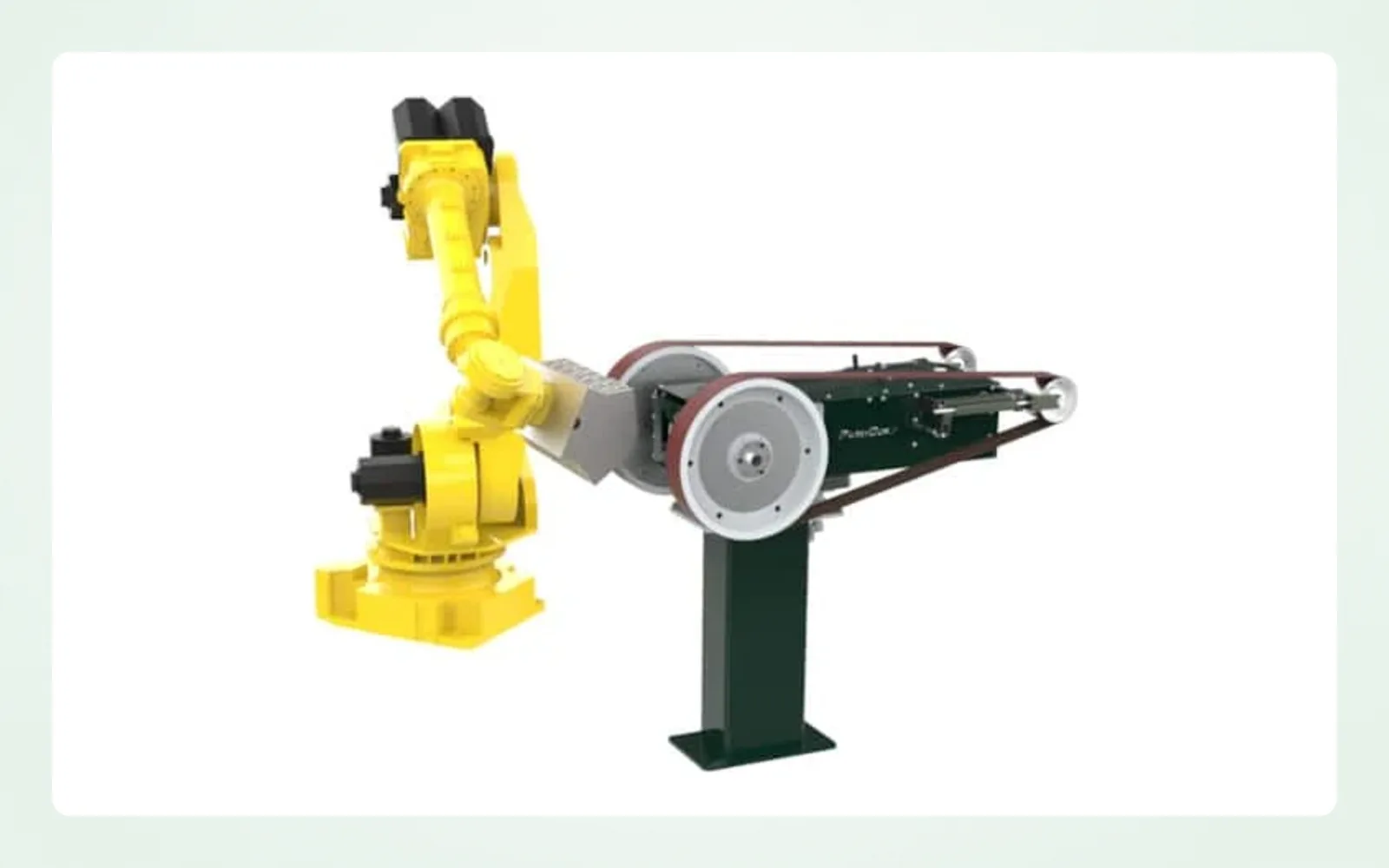
At IMTS 2026 in Chicago, PushCorp launched the STC0440-BT40: a 40-horsepower robotic grinding spindle built for the heavy stuff, casting flash, gates, and risers. Liquid-cooled servo motor, 0 to 4,000 rpm, with a standard BT40 taper that takes flap discs, grinding wheels, and end mills. It bolts straight onto PushCorp's compliance devices for contact force control.
One spindle isn't the story. The station around it is, so let's walk through the whole system in plain language.
1. Five pieces that make a station
Think of it as a grinding worker's body.
The body: the robot arm. Usually a six-axis articulated robot. Its job is to put the "hand" at every point on the part surface. It handles positioning, not pressure. That distinction matters.
The hand: the spindle. That is the PushCorp launch. Forty horsepower is roughly twenty times a typical angle grinder. It eats the hard stuff: parting-line flash, leftover gates and risers on castings. Liquid cooling keeps it alive under sustained heavy load, and the BT40 taper borrows a proven CNC standard, so tooling is easy to buy and rigid.
The sense of touch: the compliance device. The most valuable part of the system. More on this below. PushCorp pairs the spindle with its AFD1240 and AFD92 units, active and passive.
The teeth: abrasive consumables. Flap discs, grinding wheels, fiber discs. The part that actually eats metal. A robot never gets tired, so consumables burn fast and on a predictable schedule, which demands far better consistency than manual work.
The eyes and lungs: fixturing and dust extraction. The part gets clamped and located; somebody has to pull the dust out of the air. And a safety fence around the whole cell, because nobody stands next to a robot pulling 40 horsepower.
2. Eight steps from raw casting to finished part
- Load: the casting goes into the fixture and gets clamped.
- Locate: the system confirms position and calls up the right program.
- Rough grind: coarse abrasive takes off the flash and gates. Heavy work, and exactly what a 40 hp spindle is for.
- Semi-finish: a finer grit levels out the roughing marks.
- Finish: finer still, for the surface the drawing calls for.
- Tool change: the BT40 taper pays off here. Swapping abrasives works like a machining center tool change, fast and repeatable.
- Inspect: check dimensions and surface. Flash gone, nothing over-ground.
- Unload: unclamp, next part.
Nobody stands there in the middle. People show up for loading, unloading, and checks.
3. The core idea: force control is everything
This is the part worth understanding properly.
Every casting comes out a slightly different size. Tolerances are measured in millimeters. If you drive the robot along a fixed path like a CNC machine, you get the worst of both worlds: where the casting runs big, the wheel slams in, and either the abrasive breaks or the part gets pushed out of shape; where it runs small, the wheel never touches, and the flash stays exactly where it was.
So robotic grinding cannot rely on position. It relies on feel. That feel is contact force control, and it comes in two flavors.
Passive compliance is like a human wrist. A spring-loaded mechanism between the arm and the spindle yields over high spots and follows into low spots. Simple, fast, good for parts that do not vary much.
Active force control is like actually feeling with your hand. A sensor reads the contact force in real time: too much, back off; too little, push in. The controller works to maintain the configured force within the system’s operating limits. That is what PushCorp's AFD does. The real payoff is wear compensation: as the wheel wears down, the system feeds forward automatically, so the finish stays consistent from the first part to the last.
Short version: a machine tool wins on position. A grinding robot wins on steady force. Force control gives the robot a sense of touch.
4. Four numbers decide the result
No matter how expensive the cell, you are tuning four things:
Spindle speed. How fast the abrasive spins. The STC0440 runs 0 to 4,000 rpm. Low speed and high torque for heavy roughing, high speed for finishing.
Feed rate. How fast the arm moves the spindle along the part. Faster is more productive but leaves marks; slower gives a better finish but eats time.
Contact force. How hard the spindle presses into the part. More force removes faster, less force finishes finer. This is the number the force controller manages live.
Grit sequence. Coarse to fine, same as hand sanding. Nobody does the whole job with one disc. Rough, then level, then finish, step by step.
The four pull against each other, a bit like cooking: heat, time, pressure, seasoning. Change one and the dish changes. Get them right and it is called a process; get them wrong and it is called rework. The robot's real value is repeating the right recipe thousands of times without drifting. People cannot do that.
5. When a robot is actually worth it
Honestly, not every grinding job deserves a robot.
Worth it: high volume, repeating shapes, heavy parts, heavy dust, heat and noise, jobs nobody wants. Casting cleanup is the textbook case. A few hundred parts a day will wreck a human back in a year; the robot does not care.
Not worth it: one-offs, shapes that change daily, ultra-fine polishing with extreme surface demands. Programming takes longer than the job itself, and a skilled hand is still the cheaper answer there.
The GUOWIN angle: a consumable's dream and its lie detector
Once a grinding station goes into a production line, it means two things for abrasives.
First, volume. A 40 hp spindle running all day burns through abrasives several times faster than a human, and on a dead-regular schedule: which part, how many minutes per disc. That is steady orders for a supplier who never misses a shipment.
Second, quality bar. In manual grinding, a skilled worker compensates for a mediocre disc by feel. A robot cannot. The parameters are fixed, so an inconsistent abrasive turns straight into scrap. One bad batch stops the whole line. Robot customers do not buy on unit price; they buy on batch consistency and disc life.
That is the opening for products like GNOSIQ: get consistency right, cover the full spec range, and robotic grinding becomes the most reliable outlet a consumables maker can have.
Product info: Robotics 24/7 (IMTS 2026 coverage); PushCorp official materials. STC0440-BT40: 40 hp (30 kW) liquid-cooled servo spindle, 0-4,000 rpm reversible with ±5% speed regulation, BT40 taper, quad-bearing front end for high radial and axial loads, 69 N-m continuous stall torque, compatible with AFD1240/AFD92 active and passive force compliance devices.