
Sponge abrasive structure, flexible backing, grain coating and anti-loading concepts, with patent figures distinguished from product specifications.
Introduction
Sanding sponges (sponge abrasive blocks) are sanding and polishing materials made by bonding abrasive grains onto a sponge backing. They are best suited to contour sanding, absorb water, and support prolonged wet sanding — a substitute for waterproof sandpaper in many jobs. Soft in texture, they work dry or wet, are washable and reusable, and resist water, acids, and alkalis (CN111016346B).
This review has two motivations. First, the public patent US6419573B1 describes a sanding-sponge backing; its disclosed three-layer structure, grain-coating process, and anti-loading approach are available for technical study; patent status and freedom to operate require separate jurisdiction-specific review. Second, sponge abrasives are the flagship category of GUOWIN's SA series, and a systematic review of the concepts helps unify our technical language internally and externally. Drawing on three patents and one industry technical article, this review surveys seven key concepts.
The review explains how the backing, adhesive and grain coating work together, and what each element contributes to sanding performance.
1. Concept 1: The Three-Layer Structure
Public literature describes the sanding-sponge structure with remarkable consistency, reducible to three layers: backing – make coat – abrasive/size coat. The foam backing is typically polyurethane sponge, often open-cell, providing flexibility and conformability. The make coat is the adhesive layer that bonds abrasive grains to the backing surface. The size coat over the abrasive layer serves a fixing function and usually doubles as an anti-loading layer.
Performance flows clearly across the three layers: the backing determines conformability and tear-limited service life, the make coat determines grain retention and shedding rate, and the size coat determines anti-loading and chip evacuation. EP0706859B1 gives a typical backing window: open-cell polyester-type polyurethane foam, density 50–100 kg/m³, thickness 2–15 mm — thin sheets are more nimble for fine contours, thick blocks cushion better for palm sanding. These are parameters disclosed in that patent, not an industry-wide structural standard.
Interlayer bonding matters just as much: the make coat must grip the grains firmly, adhere reliably to the foam backing, and survive repeated flexing without cracking. That is why the adhesive system for sanding sponges is a research subject in its own right — you cannot simply transplant the adhesive from conventional sandpaper.
2. Concept 2: Mechanical Properties of the Flexible Backing
"Soft" is the sanding sponge's reason for being — but how soft is a matter of engineering. US6419573B1 cites ASTM D 3574-95 with a quantitative threshold: compression force deflection of less than 4 psi (about 27.6 kPa) at 50% deflection. Only when soft enough can the sponge conform to curves and spread hand pressure evenly, avoiding localized high pressure and deep scratches where a curve tightens. This is the core mechanistic advantage of a flexible backing over a rigid one.
Softness, however, creates a central tension: tear resistance. The patent text states plainly that an ordinary sanding sponge, when worked over a sharp corner such as a table edge, can be pierced and torn by the corner under hand pressure. Three lines of countermeasures appear in the research:
- Felted foam: compressing polyurethane foam 2–4× and setting it, so the collapsed cell walls markedly raise tear strength while conformability is retained; pushing the compression ratio higher hardens the foam and raises cost — diminishing returns.
- Reinforcement layers: embedding fiber or mesh into the foam during foaming, or laminating a mesh layer afterward, to raise tear resistance in all directions structurally — CN111016346B wraps the backing in two orthogonally overlaid mesh layers.
- A quantitative bar: tear strength ≥ 5 lb/in (about 880 N/m) is treated as the dividing line for being "clearly superior to conventional sanding sponges."
It must be stressed that these figures are the implementation conditions of that patent's embodiment — not industry-wide specifications.
Thickness affects feel and application in the same way: 2–5 mm thin sheets track the hand more closely, suiting fine contours and pre-polish work; blocks 10 mm and up have a thicker cushion, suiting large-area leveling and heavy-handed sanding. Thickness and firmness must be read together — at equal hardness, thicker means more "meat" and less risk of sanding through an edge.
3. Concept 3: Grain Coating and Adhesive Wicking
The typical sanding-sponge process is: liquid make coat applied to the backing surface → abrasive grains deposited → dried and cured. Process details disclosed in the 3M patent: the make coat may be sprayed, curtain-coated, or spread-coated, and after grain deposition dried at about 71°C for 2 hours. A key physical concept sits at the heart of this step — wicking.
As the patent describes it: the liquid make coat is drawn into the open surface pores of the foam, the adhesive "retreats" from around the grains, leaving only a meniscus-shaped adhesive fillet at each grain's root to clamp it in place. The result: most grains are held at a uniform height above the backing surface, cutting edges are highly exposed, and the abrasive face ends up nearly as flat as the backing surface itself. This "uniform grain protrusion" is the microscopic basis for the sanding sponge's even cutting and consistent scratch pattern.
The flip side of the concept matters equally: if the make coat is too thick and buries too much of the grain, cutting ability is "drowned." So adhesive quantity has a process window — too little means weak retention and grain shedding; too much means it won't cut and runs hotter. A good sanding sponge should show uniformly exposed grains on its abrasive face, not grains pasted over with adhesive — a criterion you can apply directly in visual inspection.
The drying and curing step sets the final strength of the adhesive layer: too cool or too short leaves the adhesive soft with poor grain retention; too hot risks heat-deforming the foam backing. The 3M patent's embodiment — about 71°C for 2 hours — can be taken as a reference point balancing adhesive cure against backing stability.
4. Concept 4: Anti-Loading
Loading is the dominant failure mode when abrasives work soft substrates such as paint, putty, and primer: dust packs the spaces between grains, the abrasive face gets "pasted shut," cutting fades, and drag marks appear on the workpiece. Three countermeasure families appear in the public research:
First, a hard anti-loading size coat — a second, hard anti-loading coating over the abrasive layer (the 3M patent route) so dust adheres poorly and sheds easily. Second, wash-assisted chip evacuation — the sponge backing absorbs water, and during wet sanding the water flow carries fine swarf away; after use the sponge can be rinsed and dried for reuse. This is a structural advantage of sanding sponges over conventional sandpaper. Third, structural chip evacuation — chip grooves formed between zones of the abrasive layer (CN111016346B), letting swarf exit through the channels instead of accumulating in the cutting zone.
The three are not mutually exclusive: the anti-loading coat solves "sticking," washing solves "removal," and grooves solve "routing." For the fine-grit segment aimed at paint sanding (e.g., P180–P3000), anti-loading capability is the first selection criterion.
From a usage standpoint, wet sanding is the most economical anti-loading method: continuous water flow both cools and evacuates chips; when sanding dry, clean the abrasive face frequently and don't grind one spot to the end. Products with higher anti-loading grades typically have a harder size coat and more "open" spacing between grains, at the cost of slightly lower absolute cutting power — match the grade to the softness of the substrate rather than always chasing the highest grade.
5. Concept 5: Grit Grading and Selection Logic
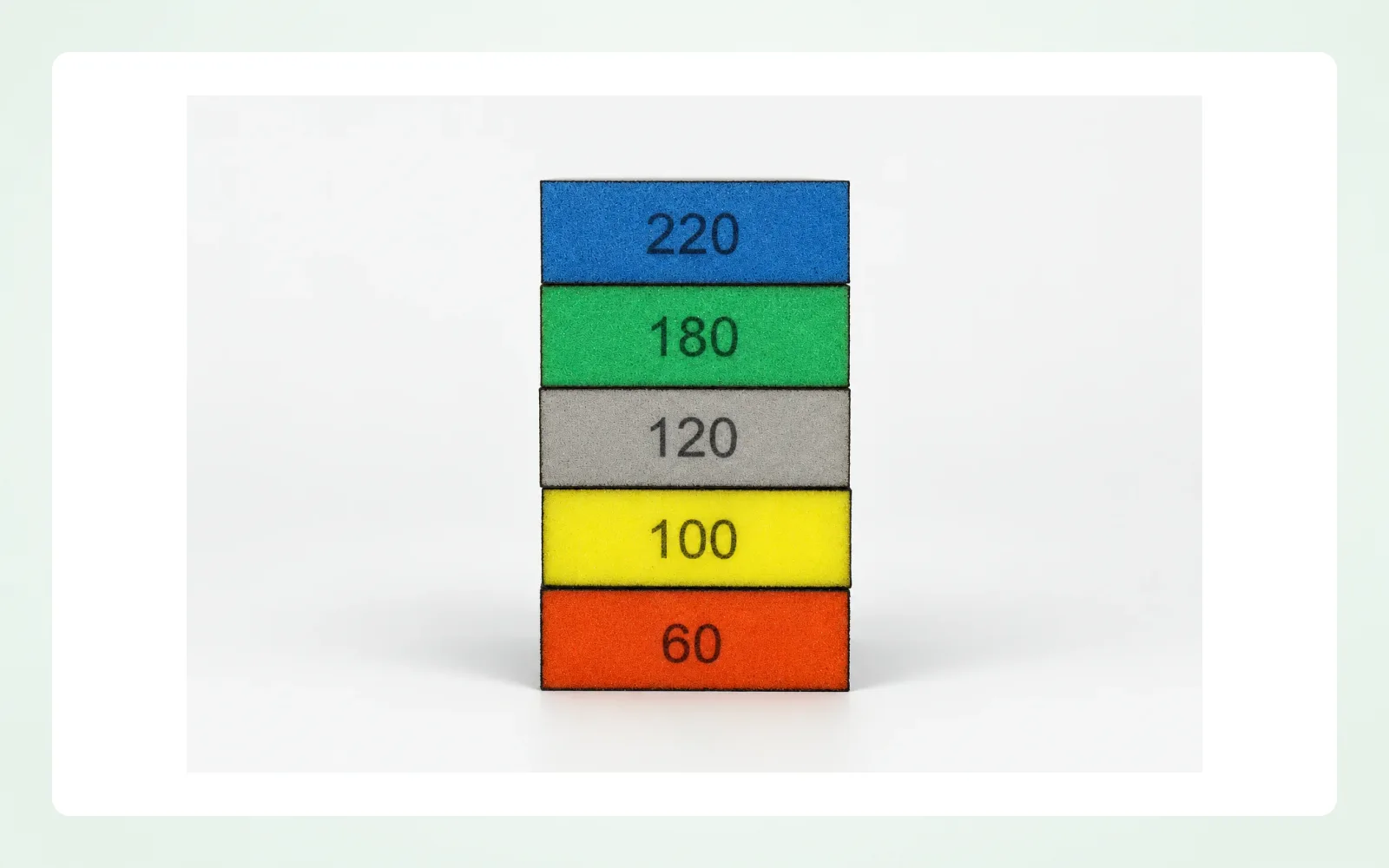
Industry practice divides products into coarse, medium, and fine grades, distinguished by color coding (color systems differ by manufacturer — always go by grit number when comparing across brands). Coarse grits handle heavy removal, deburring, and leveling; medium grits handle flattening and transitions; fine grits handle finishing and pre-polish work.
Sanding sponges support dry and wet use; wet sanding with running-water rinsing reduces loading, extends life, and yields a more consistent scratch pattern. Applications span woodworking (panel leveling, pre-stain prep), automotive refinishing (putty and primer leveling, blend transitions), hard-plastic and fiberglass repair, furniture refinishing, and metal pretreatment — all sharing "contours + hand work + fear of sanding through," which is exactly the flexible backing's home turf. The selection logic compresses to one sentence: choose coarseness by removal volume first, thickness and firmness by curvature second, and anti-loading grade by substrate softness last.
A common mistake is "one coarse grit all the way": deep scratches from coarse grit take multiple fine passes to cover, costing more labor overall. The correct approach is a stepped progression — e.g., P80 → P180 → P320 — where each step only has to erase the previous step's scratches.
6. Concept 6: Manufacturing Process
Synthesizing the patent disclosures, sanding-sponge production reduces to: backing preparation → reinforcement lamination → make-coat application → grain deposition → drying and curing → size-coat application → die-cutting. CN111016346B identifies a typical flaw of older processes: directly mixing abrasive with adhesive and coating the blend produces sponges with poor tear strength that rip easily — the admixed abrasive disrupts the continuity of the adhesive film.
That patent's fix is structural: wrap the backing in mesh layers before grain deposition, with two mesh layers overlaid orthogonally, so tear resistance rises in every direction; at the same time, chip grooves are formed between abrasive zones for evacuation. The lesson: process improvement in sanding sponges is usually "better structure," not "better glue" — build mechanical reinforcement and functional structure into the backing instead of asking the adhesive layer to do everything.
The die-cutting step then sets the final form: blocks for hand grip, sheets for machine-mounted discs, shaped blocks for specific contours. One grain-coating line can cover many forms simply by changing cutting dies — one reason the category cost of expanding a sanding-sponge lineup is relatively low.
7. Concept 7: Positioning Against Conventional Sandpaper
Sanding sponges are routinely compared with conventional sandpaper (especially waterproof paper), and the CN patent explicitly mentions substituting for waterproof sandpaper. The essential difference is the backing: rigid paper vs. flexible foam. Paper's strengths are flatness and sharp cutting, suiting efficient removal on large flat areas; foam's strengths are contour conformance, even pressure distribution, and resistance to sanding through edges.
A second difference is the life model: sandpaper is largely single-use — loaded means discarded; sanding sponges are washable and reusable, so lifetime cost should be compared per use, not per unit price. Boundaries must be acknowledged too: heavy removal on large flat areas remains the territory of sandpaper and belts; the sanding sponge's home is contours, edges, and finishing. The two are complementary, not substitutes.
8. Summary and Outlook
Across the public literature, the concept map of sponge abrasives is fairly complete: the three-layer structure is consensus, the flexible backing's mechanical window (compression deflection, tear strength) has quantitative thresholds, wicking explains the mechanism of uniform grain protrusion, anti-loading has three routes (coating / washing / evacuation), and process improvement points toward structural reinforcement rather than adhesive substitution.
Directions that remain under-disclosed and worth tracking: first, third-party data on quantitative relationships is scarce — most figures are self-reported in patent texts, with little independent comparative testing. Second, machine use — the EP patent already shows hook-and-loop-backed sponge discs for orbital/random-orbit sanders, and the hand-to-machine extension is a clear trend. Third, specialized anti-loading — formulations tuned to different dust characteristics (paint vs. putty) are the main battlefield for differentiation. Fourth, thin and shaped forms — 3–5 mm thin sheets and profiled blocks serving fine-contour scenarios in 3C electronics and automotive interiors.
References
- US6419573B1, Sanding sponge with high tear strength backing layer, 3M Innovative Properties Co., 2002 . — Felted-foam backing, wicking grain deposition, anti-loading size coat.
- EP0706859B1, Abrasive materials (direct-coated sponge abrasives). — Open-cell polyurethane foam backing parameters, hook-and-loop machine-use form.
- CN111016346B, "A sponge abrasive for metal products and its production method" (一种用于金属制品用的海绵砂及其生产方法). — Chinese definition of sanding sponge, mesh-reinforced tear resistance, chip grooves.
- Kamel Abrasives, "Speciality Sanding Sponge", Medium, 2026-09. — Color coding, dry/wet use, coarse/medium/fine grading and applications (vendor technical article; only generic technical points taken).
Note: this is a concept review; all statements are rewritten, not copied. Specific product parameters are subject to GUOWIN's own testing and factory confirmation.