
Match wool, microfiber and foam pads to the correction stage, machine and required finish.
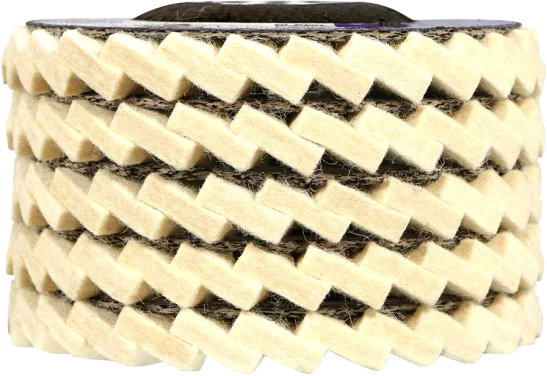
Answer first: Ask a room of detailers which pad is best and you will get three answers. Wool cuts hardest (Lake Country rates its blue wool pad to remove P1500 scratches), microfiber works a two-step correction (Meguiar's DA Microfiber system promises swirl-free results in two steps), foam finishes finest (S.M. Arnold's finishing foam is rated 70 PPI). Pick the step first, then the material.
Question source: RUPES YouTube video title, "Top Polishing Pads For Detailing (microfiber, wool, foam — which pad for best results)"
Start with a better question
"Which pad gives the best results" is the wrong question. The three materials are three different cutting mechanisms, and asking which is "best" is like asking whether a hammer beats a wrench. The right question is: which pad belongs at this step of the job.
- Wool cuts with fibers. Lake Country's twisted wool spins 100% wool into hundreds of individual strands, each fiber a small cutting edge, aimed at severe swirls, deep scratches, and heavy oxidation. Open between the fibers, it runs relatively cool, one reason it dominates gelcoat work.
- Microfiber cuts with thousands of ultra-fine fibers working together. Each fiber is fine, so the cut is even: fast cut, light haze. Meguiar's built a whole category on it with the DA Microfiber system, the DMC6 cutting disc with D300 compound for step one and the DMF6 finishing disc with D301 finishing wax for step two.
- Foam cuts with cell structure. A foam pad's cut and finish depend on cell structure, firmness, material, pad geometry and the compound-machine combination. PPI means pores per inch, not density. S.M. Arnold prints 70 PPI on its finishing foam spec sheet.
Wool: the heavy-cutting choice, with a haze bill
Wool owns the heavy work: severely oxidized paint, deep scratches, hard paint systems, gelcoat. Nobody disputes it cuts fastest of the three.
The bill: haze. The fine texture wool fibers leave behind almost always needs a second, refining step. Expecting a mirror in one wool step is the most common mistake in the category. The second bill is caking: fibers loaded with compound residue mat down and the cut falls off. Lake Country's twisted-wool instructions give two fixes: clean using the approved pad-cleaning method and keep suitable clean pads in rotation. Stop the machine before inspecting or changing the pad.
When shopping, confirm the pile height and machine compatibility for the exact product and size. Do not assume every wool-pad family shares one size-to-pile-height mapping.
Microfiber: the DA polisher's middle ground
Microfiber pads were born for dual-action (DA) polishers. Meguiar's puts it plainly: their DA Microfiber system achieved defect removal "previously unheard of" with a DA polisher. Its sweet spot is light-to-moderate defects, swirls, acid rain spots, light scratches, corrected in one pass, with haze light enough to deliver the car.
But microfiber has three clear weaknesses. First, it hates dirt: fibers loaded with compound residue lose cut immediately, and it has the highest pad-cleaning demand of the three. Second, it hates curves: Meguiar's own DMC6 cutting-disc page says "Best on flat surfaces." Third, it hates heat: lose control of speed and pressure and microfiber hazes like anything else.
The standard method is the two-disc system Meguiar's defined: cutting disc plus compound for the first pass, finishing disc plus finishing wax for the second. The cited Meguiar’s method is a two-step system; a one-step result requires a separate test on the actual paint and defects.
Foam: the widest range, irreplaceable at finishing
Foam covers the most ground of the three materials: from heavy-cutting foam to ultra-fine finishing foam, one material walks the whole process. The final refining stage is foam's undisputed territory. Ultra-fine foam with a finishing polish is the standard last step before a coating. Foam is also predictable: the same pad, a stable cut, every panel.
Foam's weakness is heavy cutting. Grinding through deep scratches or heavy oxidation is not impossible with foam, just far slower than with wool or microfiber. Get the step wrong and no pad saves the job.
Foam's grading language is color. Lake Country's CCS line grades cut by color: yellow for heavy cutting, orange for light cutting, white for polishing (per dealer product descriptions). Shop foam by color grade first, then by PPI or density rating. If neither is published, be cautious.
Choose by step
- Read the defect. Deep scratches, heavy oxidation → wool. Light-to-moderate swirls → microfiber cutting disc. Haze, minor marring → foam polishing pad. Spreading sealant or wax → foam finishing pad.
- Read the machine. Rotary plus wool is the classic heavy-cut combo. DA plus microfiber is the modern standard answer. Finishing is foam on either machine.
- Read the delivery standard. For a one-step service, validate a suitable pad and polish; a two-disc correction system remains two steps. Show-car mirror → minimum two steps, cut then refine.
- Don't economize on pads. Mixing cutting and finishing pads is a rework factory. Pads are consumables. Record consumable and rework costs for each stage.
Mistakes worth avoiding
Running wool in one step, then complaining about haze. Wool's product logic assumes a second refining step. A one-step mirror was never its design target.
Grinding deep scratches with foam. The pad is not wrong; the step is. Heavy cutting belongs to wool and microfiber. Foam's advantage is in the back half of the job.
Forcing microfiber on curves. The manufacturer itself wrote "best on flat surfaces." Use a smaller pad or switch to foam on curves and edges instead of fighting physics.
The takeaway
Choosing a pad is not choosing the "strongest material." It is matching the right pad to every step. Wool and microfiber do the cutting; foam does the finishing. Keep several pads in rotation, and never mix steps. GNOSIQ pad grades and specifications follow the official published specs.
Sources: question from the RUPES YouTube video title (https://www.youtube.com/watch?v=HYHAKZ9jGow); Lake Country twisted wool specs and use notes (100% twisted wool strands, for severe swirls/deep scratches/heavy oxidation, steel-brush fluffing or multi-pad rotation, pile heights by size) at https://www.goldlabelcarcare.co.uk/products/lake-country-twisted-wool-curved-cutting-pad; Lake Country blue wool pad P1500 rating at https://lakecountrymfg.com/products/blue-hybrid-knitted-wool-pads/; Meguiar's DA Microfiber system (DMC6 + D300, DMF6 + D301 two-step system, "swirl-free results in two easy steps," "Best on flat surfaces," "levels of defect removal previously unheard of with a dual-action polisher") at https://www.meguiars.com/professional/products/meguiarsr-da-microfiber-cutting-disc-6-inch-dmc6-2-pack; microfiber "adapt to curves and contours, distributing the abrasives evenly" mechanism at https://meguiars.co.nz/product/meguiars-dmc6-da-microfiber-cutting-disc-2-pack; S.M. Arnold 70 PPI at https://sonnysdirect.com/parts/40001375-polishing-foam-pad-6in-dia-70-pores-per-inch-ppi-flat-pad-blue-polyester-sm-arnold-44-136; Lake Country CCS color grading (yellow/orange/white) from dealer product descriptions; GNOSIQ specs per the official site.
Specification note: PPI counts pores per inch; it is not mass density and cannot by itself determine cutting or finish. Pad color grades are manufacturer- and product-line-specific. Confirm pad, machine, compound, surface and cleaning instructions together.
Manufacturer references: https://lakecountrymfg.com/faqs/ ; https://lakecountrymfg.com/pad-technology/ ; https://lakecountrymfg.com/products/blue-hybrid-knitted-wool-pads/ ; https://www.meguiars.com/sites/default/files/pdf/professional-catalog.pdf