
Assess bonding, foam structure, heat and rework to compare the actual cost of polishing pads.
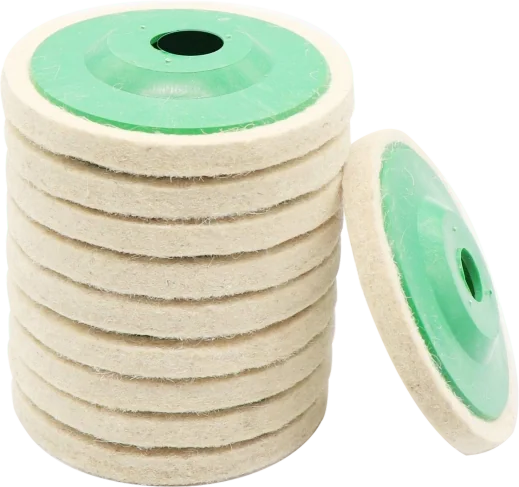
Answer first: Cheap pads cost you rework, not the sticker price: delamination, uneven foam, heat collapse, shedding. For reference, Lake Country rates its blue wool pad to remove P1500 scratches, a claim you can print on a spec sheet. Check the specific product datasheet rather than assuming price establishes performance.
Question source: Reddit r/AutoDetailing, "What is the drawback of cheap polishing pads?"
What "cheap" really means
Low price alone does not prove poor quality. The quality risks to check are: low-grade foam with uneven pore size and density; low-grade adhesive with poor heat resistance or uneven application; and low-grade QC, where two pads from the same batch can feel like different products. The sticker price is low because the savings went into the places you cannot see.
Unstable cutting
Cutting power in a foam pad comes from the partnership between the abrasive and the foam. Lake Country's Force Hybrid technical notes state the mechanism plainly: the denser the foam, the more the abrasive stays on the foam surface and in contact with the paint; in loose, open foam, the abrasive sinks into the cells, the paint sees less cutting, and the pad wears out faster.
A cheap pad with uneven pores cuts harder in some spots and weaker in others. The result is over-polished areas next to scratches that are still there. You thought you saved a polishing step. You actually bought yourself a second one.
Heat
Polishing generates heat. Spin faster, press harder, work longer, and the pad face gets hotter. A veteran on the Tundra detailing forum put it bluntly: heat kills pads the quickest. Quality pads use adhesives and foams that survive this heat. Cheap pads soften their adhesive first, then delaminate, curl at the edges, and in the worst cases fly apart.
Delamination is not "underperforming." It is a pad coming apart on a machine spinning at thousands of RPM. The safety bill is far larger than the efficiency bill.
Collapse
Low-density foam cannot hold up under pressure. Push the polisher down and the pad face collapses: the edges lift and dig into the paint while the center sinks and stops cutting. Your technique is standard, but the result is not. That is not a technique problem. It is a pad that cannot support itself.
Shedding
Wool pads shed fibers, microfiber pads shed lint, foam pads shed crumbs. The debris mixes into your compound and becomes a new source of scratches. One forum user's retirement rule is simple: when the pad starts leaving foam residue on the paint, it is done. A cheap pad reaches that moment much sooner.
Backing-plate fit
A hook-and-loop backing that bonds loosely, sits off-center, or varies in thickness will vibrate on the machine. Vibration does two things: it makes the polisher jump until your arms give out, and it distributes pressure unevenly across the pad face, which invites holograms. A good pad's tolerances are engineered. A bad pad's are "close enough."
The real ledger
The true cost of a cheap pad is not its price. It is the per-car consumable cost plus rework time: pads dying early, unstable finishes that need redoing, extra compound consumed. Add those three lines up and they dwarf whatever the pad saved. Professional shops price per car, not per pad.
When a cheap pad is honestly fine
Honestly, cheap pads have their place. Waxing or sealing, where the pad only spreads product and cuts nothing. Practice work for beginners, where pads are destined to be destroyed anyway. One-off jobs that never enter a rotation. But the moment cutting is involved, or the car belongs to a customer, the math stops working.
How to pick a reliable pad
Ignore the brand and check four things:
- Even foam. Hold the pad against the light: pore size should be consistent and rebound even when you press it. S.M. Arnold's foam pad specs print 70 PPI (pores per inch). PPI is pore count, not foam mass density; ask separately about construction and intended use. A pad that cannot publish one deserves a question mark.
- Solid bonding. With the machine disconnected, inspect for lifting, tears and backing damage. Do not peel the bonded layers apart as a usability test; remove damaged pads from service.
- Published specs. A manufacturer that prints cutting ability, recommended speed range, and suggested compounds on the sheet probably has QC to match.
- Washable. A pad that survives normal washing without falling apart has a baseline lifespan worth paying for.
The bottom line
Pads are consumables, but consumable does not mean disposable. Cutting demands uniformity across every inch of the pad face, and material savings can be offset by extra rework; measure the actual cost per completed job. GNOSIQ pad density and specifications follow the official published specs.
Sources: question source via Reddit r/AutoDetailing ; S.M. Arnold 70 PPI foam pad spec at https://sonnysdirect.com/parts/40001375-polishing-foam-pad-6in-dia-70-pores-per-inch-ppi-flat-pad-blue-polyester-sm-arnold-44-136; Lake Country blue wool pad P1500 rating from its product description at https://lakecountrymfg.com/products/blue-hybrid-knitted-wool-pads/; "denser foam keeps abrasives on the surface" mechanism from Lake Country Force Hybrid notes at https://www.autogeek.net/lc-fr-hgrey3.html; "heat kills pads the quickest" from a Tundra forum user's experience at https://www.tundras.com/threads/how-do-you-know.159184/; GNOSIQ specs per official site.
Specification note: PPI counts pores per inch; it is not mass density and cannot by itself determine cutting or finish. Pad color grades are manufacturer- and product-line-specific. Confirm pad, machine, compound, surface and cleaning instructions together.
Manufacturer references: https://lakecountrymfg.com/faqs/ ; https://lakecountrymfg.com/pad-technology/ ; https://lakecountrymfg.com/products/blue-hybrid-knitted-wool-pads/ ; https://www.meguiars.com/sites/default/files/pdf/professional-catalog.pdf