
Select angle-grinder abrasives around finish, total cost, throughput and rework risk.
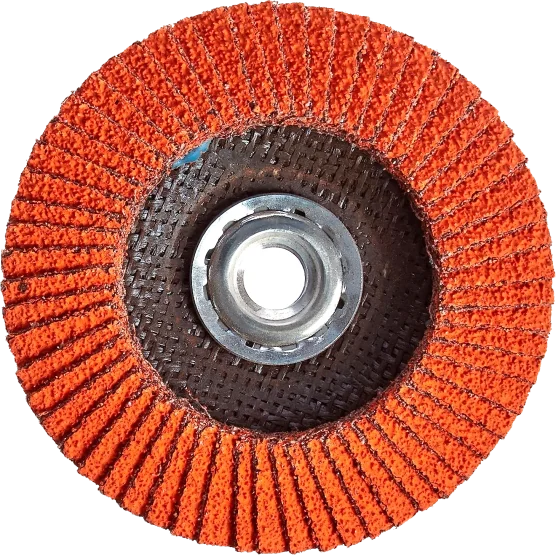
Answer first: Before buying angle-grinder finishing abrasives, answer four questions: Does surface finish matter? Unit price or total cost? Throughput or rework risk? Flap discs grind and finish in one pass, with a service life roughly equal to 15–20 resin-fiber discs (The Fabricator, 2017). GNOSIQ flap discs come in five constructions on 4–7 in. T27/T29 platforms.
Question source: The Fabricator, "How to choose the right surface finishing product" (2017-05-10); the "15–20 discs" figure is quoted from that article; GNOSIQ specs from customer product documentation v1.0 (2026-09-29).
The two most common mistakes in a metal shop are mirror images of each other: always buying the cheapest abrasive, or always buying the toughest one. Both can be wrong, because there is no universally best grinding consumable, only the right one for the job at hand. The Fabricator's selection framework still holds up years later: know the three product types, then answer four questions.
The three contenders
For angle-grinder surface work there are three options: grinding wheels, flap discs, and resin-fiber discs. Compared at the same grain type and wheel size, they behave very differently:
| Grinding wheel | Flap disc | Resin-fiber disc | |
|---|---|---|---|
| Life | Longest, most durable | Middle (far outlasts resin-fiber) | Shortest by far |
| Cut rate | Relatively slow | Fast | Very fast at first, then fades |
| Finish | Roughest | Grinds and finishes in one pass, consistent throughout | Degrades continuously as it wears |
| Initial price | Middle | Highest | Lowest |
| Caveat | — | — | Needs a backing pad (extra cost) |
Think of them as personalities. The grinding wheel is the endurance type. Slow cut, long life, rough finish. The flap disc is the all-rounder: one pass grinds and blends, and the finish stays consistent from the first minute to the last. It just costs the most up front. Then there is the sprinter, the resin-fiber disc. Blazing fast out of the gate, but the grains dull on the very first use, so cut rate and finish slide downhill from there. It also cannot run without a backing pad, and the pad's cost plus its hardness (which changes performance) belong in your math. One structural quirk: a plain-arbor resin-fiber disc can foul against the lock nut at low approach angles or in tight spots.
Question 1: Is surface finish important?
This is the fork in the road.
If finish does not matter, a grinding wheel is perfectly acceptable. It lives the longest and its initial price sits below a flap disc. In a pure longevity contest, the wheel wins.
If finish does matter, go with a flap disc. It blends as it grinds, delivering a consistent finish in one pass instead of rough-grinding first and finishing with a second tool. Two operations collapse into one, and the savings go beyond abrasive cost.
A resin-fiber disc can grind and finish too, but its finish quality starts degrading from the first use. Expecting a consistent finish across its whole life is unrealistic.
There is a fourth combination: rough-grind with a wheel, then finish with a separate tool. That stretches the finishing tool's life, but adds labor time. Whether it pays depends on whether your labor or your abrasives cost more.
Question 2: Unit price or total cost?
This is where purchasing and the shop floor usually disagree.
On initial price alone, the resin-fiber disc is cheapest. For small jobs and occasional use, it is the right call.
But The Fabricator ran the numbers in the original article: matching the life of one flap disc can take 15 to 20 resin-fiber discs. That is before counting the backing pad, the pad changes, and the downtime. The number the shop should track is total cost: abrasives plus changeover time plus labor. By that measure, the flap disc with the highest sticker price is often the cheapest option overall.
So the real question is job size. Small job: the resin-fiber disc's total cost genuinely is lower. Big job: the flap disc's total cost usually wins. Do not buy big-job abrasives with small-job logic.
Question 3: Do you need more throughput?
If you want speed, check the finish requirement first.
Need finish and speed: flap disc. One pass does two jobs, and the saved labor hours convert directly into throughput. That is why a product with the highest initial price still sells.
Finish irrelevant: grinding wheel. Cut rate, life expectancy, and durability move jobs out the door faster.
The resin-fiber disc is built for small batches and emergencies. Running production volumes on it means changing discs constantly, and your throughput dies in changeovers.
Question 4: Are you worried about damaging the workpiece?
The grinding wheel is the most rigid of the three, and rigidity gouges. Push too hard or let it slip and it cuts a groove into the part. Rework costs an order of magnitude more than the abrasive.
The original article offers one practical tip: with a new grinding wheel, take the first stroke pulling toward you rather than pushing away. It reduces the chance of gouging. Small habit, big savings.
Wheels also retain heat. Grinding stainless too aggressively blues the surface, and blued material means rework. Flap discs are far more forgiving; a heavy hand or a slip rarely leaves a deep gouge. Resin-fiber discs sit in the middle, with forgiveness set by the backing pad you pair them with.
Once you land on flap discs: five GNOSIQ constructions by application
The four questions pick the category. Within flap discs, match the construction to the workpiece and target finish. The GNOSIQ FD line currently runs five constructions on a common 4–7 in. T27/T29 platform:
- GN-FD-AO41 aluminum oxide: weld grinding, edge and surface blending; the general-purpose choice
- GN-FD-CA43 ceramic: high-efficiency grinding, stainless work; for hard jobs and difficult alloys
- GN-FD-ZA45 zirconia alumina: weld grinding, metal surface treatment; heavy stock removal
- GN-FD-NW47 non-woven: surface blending, satin finishes; where you want texture without scratches
- GN-FD-WL49A / WL49B wool: final polishing, the last step
Five inputs get you a correct match the first time: preferred abrasive construction, T27 or T29 shape, diameter and bore, tool speed, and target surface finish. Specs as published on the official site.
The bottom line
Do not shop for the toughest or the cheapest abrasive. Answer four questions first: finish, total cost, throughput, rework risk. The category picks itself; then match the construction to the job. In that order.
Selection framework and the "15–20 discs" figure from The Fabricator, "How to choose the right surface finishing product" (2017-05-10, https://www.thefabricator.com/thewelder/article/cuttingweldprep/how-to-choose-the-right-surface-finishing-product); GNOSIQ FD specs from customer product documentation v1.0 (2026-09-29), as published on the official site.
The cited 15–20-disc comparison is a dated source example, not a universal life ratio or a GNOSIQ performance guarantee. Validate total cost on the actual workpiece, grade, machine and operating conditions.