
HTF’s public outlook highlights ceramic grains and automation, with discrepancies in its published growth figures.
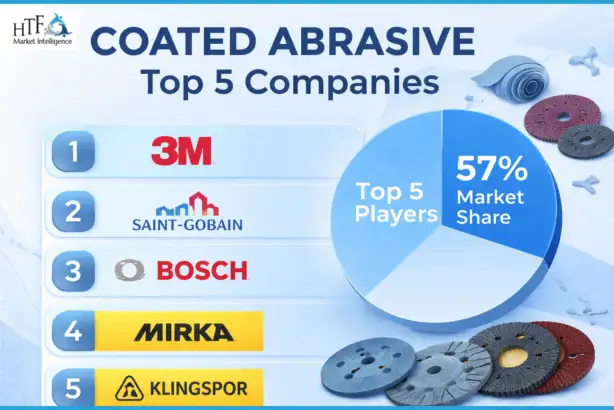
HTF Market Intelligence’s public report page puts the global coated abrasive market at USD 15.2 billion in 2025 and projects USD 20.3 billion in 2033. It identifies ceramic as the fastest-growing grain segment and metal fabrication as the largest application. These are the publisher’s estimates, rather than independently verified market measurements.
Read the growth figures carefully
The page states a 6.3% CAGR for 2026–2033. The published 2025 and 2033 market sizes imply approximately 3.7% annual growth over eight years. The figures do not reconcile. The same page gives Asia Pacific growth as 8.1% in one section and 6.9% elsewhere. This review retains the discrepancies rather than presenting a single confirmed growth rate.
Six findings for abrasive buyers and suppliers
Asia Pacific is the largest regional market in the report, at about 35%, followed by North America at 30%. Regional manufacturing demand matters, although the conflicting regional growth figures limit the precision of a forecast.
Aluminum oxide remains the established base, at 62% of the grain segment. Ceramic is identified as the fastest-growing subsegment. The commercial question is where higher removal efficiency and longer useful life can offset purchase cost; actual benefits need application trials.
Metal fabrication accounts for 57% of applications, with machinery identified as the fastest-growing use. Automotive, aerospace, woodworking, electronics and shipbuilding also appear in the report’s scope.
The top five suppliers are said to hold 57%, with CR3 at 40%. This suggests meaningful concentration while leaving room for application specialization. The report profiles Saint-Gobain, 3M, Klingspor, Mirka, Sia, Hermes, Deerfos and VSM among other suppliers.
Automation changes what buyers need from consumables. Robotic grinding lines require consistent dimensions and predictable wear. Backing flexibility, coating structure, resistance to loading and heat management affect how stable the process remains as the abrasive wears.
New applications include aerospace components, EV and battery manufacturing, medical devices, electronics and additive manufacturing. Their shared requirement is repeatable surface quality, which makes process validation more consequential.
What this means for GUOWIN
A high-performance abrasive should be evaluated through removal rate, useful life, finish quality and total process cost. Catalogue positioning alone cannot establish a performance advantage.
GUOWIN’s earlier robotic grinding article explains why consumable consistency matters in automation. This market overview supports discussing that requirement with buyers, while the proposed product and process still need validation on representative parts.
Regional demand also makes supply reliability and controllable lead times relevant. The practical opportunity is to document measurable efficiency improvements and stable delivery, then compare them with the customer’s current process.
Source and scope
This review uses the publicly accessible HTF report page. The paid full report was not acquired, and its detailed methods and underlying data were not independently examined.